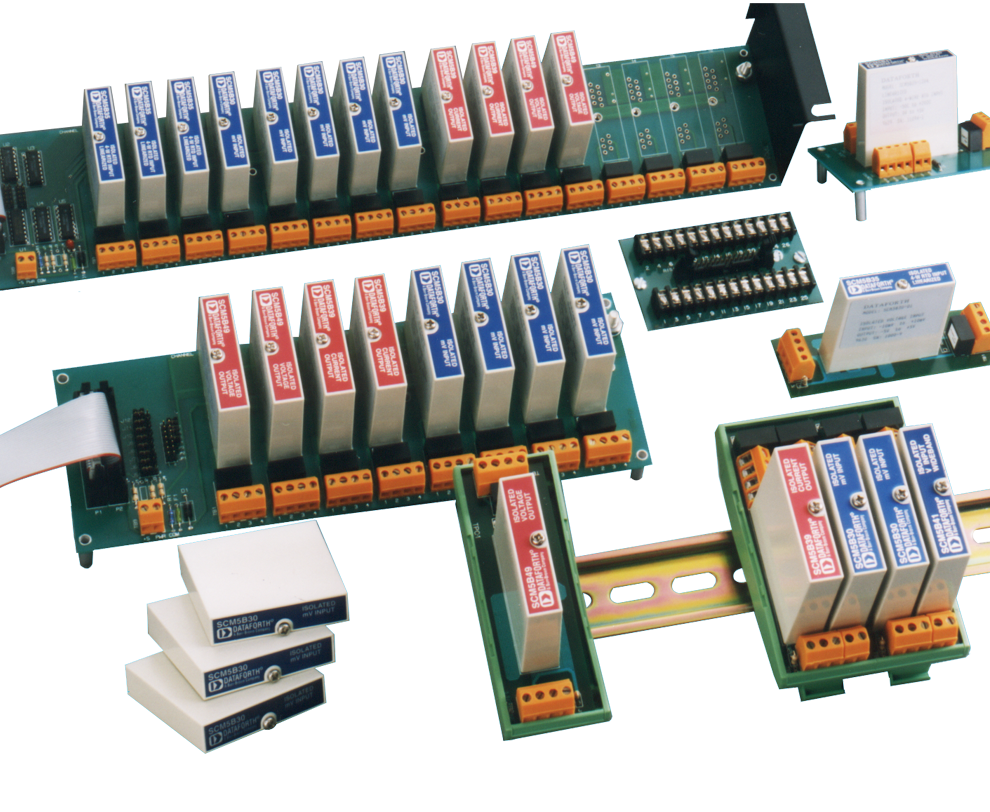
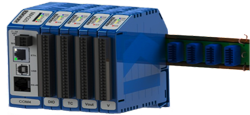
The 8B isoLynx® SLX300 - Dataforth's newly introduced data acquisition system - builds on the proven reliability and outstanding performance of the SCM5B isoLynx® SLX200 and the miniature-sized SensorLex® 8B isolated signal conditioning modules to provide a compact, low cost solution for wide ranging rugged industrial applications.
ReDAQ® Shape is Dataforth's new out-of-the-box DAQ software designed specifically for the 8B isoLynx® SLX300 system; it provides the easiest and most efficient development tool to create, save, and open graphical user interface projects as well as to test, process, and analyze acquired data.
Using industry standard Modbus RTU or TCP protocols, the 8B isoLynx® SLX300 enables communication with a broad range of existing third-party software tools and HMI/SCADA packages. Pluggable modules provide the system with maximum flexibility of analog and digital channel configuration (choose from 70 analog and 14 digital I/O modules), making it ideal for factory automation, process control, test and measurement, machine control, and data acquisition applications. The SLX300 also offers advanced features including high-speed acquisition (to 100kS/s burst), alarms, counters, and timers.
The SLX300's modular design can be configured with up to twelve channels of isolated analog input, four channels of isolated analog output, and eight channels of isolated digital I/O using Dataforth's SensorLex® 8B analog and SCMD digital modules. Multiple powerful, high-speed microcontrollers and high performance data converters at the heart of the SLX300 system enable simultaneous analog and digital I/O at sustained rates of up to 3.0kS/s.
Ensuring powerful functionality, the eight digital I/O channels can be configured to perform seven different advanced special functions: pulse/frequency counter, pulse/frequency counter with de-bounce, waveform measurement, time between events, frequency generator, pulse width modulation (PWM) generator, and one-shot pulse generator. The 8B isoLynx® SLX300 also enables four alarm states - high, high-high, low, and low-low - to be set on the analog input and digital I/O special function channels with alarm output mapped to a user selectable analog or digital output channel.