|
User Manuals
Directory of User Manuals for Dataforth Products
|
Related Topics
Popular Links
|
|
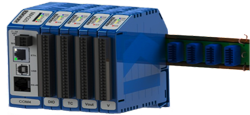
MAQ20® Industrial Data Acquisition and Control System
The MAQ®20 system consists of a family of DIN rail mounted, programmable, multi-channel signal conditioning input and output modules and
communication modules. Modules mount on the industry standard 35x7.5mm gull-wing DIN rail; a backbone mounts within the rail to provide
power and communication interconnections between the communication modules and each I/O module. The system offers the lowest cost per
channel, as well as ±0.035% accuracy, 1500Vrms channel-to-bus isolation, 240Vrms continuous input protection, and ANSI/IEEE C37.90.1
transient protection. Input power is from 7 to 34VDC and the operating temperature range is from -40°C to +85°C. Product integrity is
ensured by a 48-hour factory burn-in at 85°C.
8B isoLynx® Data Acquisition System (SLX300)
The flexible, modular SLX300 can be configured with up to 12 channels of isolated analog input, 4 channels of isolated analog output,
and 8 channels of isolated digital I/O using low-cost Dataforth 8B and SCMD modules. The system enables simultaneous analog and
digital I/O at sustained rates of up to 3.0kS/s (100kS/s burst), follows Modbus RTU/TCP protocols, and offers 7 advanced special
functions, 4 alarm states, and 3 packaging formats (panel mount, DIN rail, and 1U enclosure). To ensure signal integrity, all I/O
is input-to-output and channel-to-channel isolated.
5B isoLynx® Data Acquisition Systems (SLX200)
Dataforth's 5B isoLynx® SLX200 is fast, intelligent, modular, and fully isolated. Able to interface with 650+ 5B analog I/O modules and
supported by ReDAQ® Freedom software, the SLX200 provides maximum flexibility, reliability, and accuracy for factory automation,
process control, test/measurement, machine control, and data acquisition applications. Certified by Modbus-IDA and OPC-compatible,
the SLX200 implements industry standard Modbus RTU and TCP protocols, enabling communication with third-party software drivers and
HMI packages. To ensure signal integrity, all I/O is input-to-output and channel-to-channel isolated.
|