The math associated with the calculating total communication system SNR can get complicated; however, the basic definition is straightforward. The basic mathematical definition of SNR is;
SNR = 10*Log(Signal Power / Noise Power) , or
SNR = 20*Log(Signal Voltage, rms / Noise Voltage, rms)
Calculating the actual signal and all the noise voltage sources can be complicated. As one example, consider an analog to digital converter, ADC unit associated with data acquisition. These units inject “quantization nose” since there is quantization conversion uncertainty of ± LSB/2. An N-bit ADC with a sinusoidal signal input has a signal- to-noise ratio . If this ADC is operated in the over sampling mode, then the signal-to-noise ratio is given by SNR = 6.02*N+1.76 dB + Log(OSR), where OSR (over sampling ratio) is defined as the ratio of sampling frequency (fs) to twice the bandwidth limited signal frequency (fo) , OSR=fs / 2*fo. These simple examples illustrate that as communication systems become more complex, accurately calculating SNR becomes equally complicated.
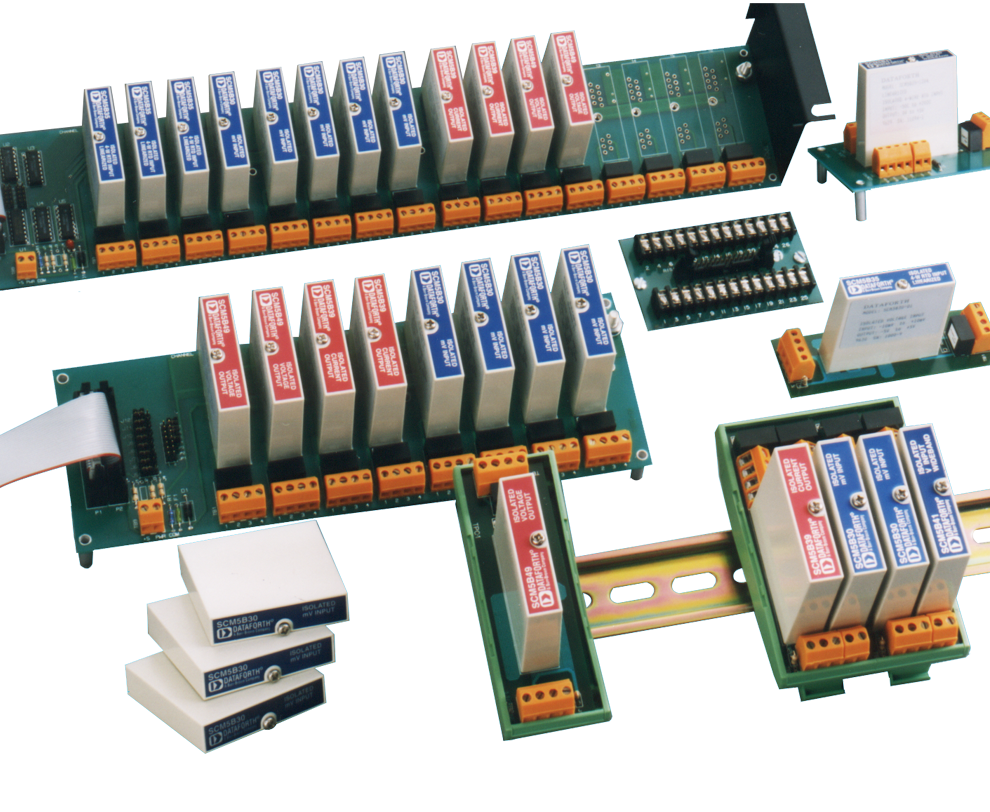
Although the SNR as a figure of merit does not generally apply to industrial process instrumentation and control modules, one can calculate a basic number from Dataforth specifications. For example, Dataforth’s SCM5B30 Analog Voltage Input Module, Narrow Bandwidth has a maximum output of 1 VDC (same as RMS) and a maximum noise output of 200 micro-volts, RMS. These specifications give a SNR of 20*log (1÷200E-6) = 74dB, which means a 1 volt output is 5000 times larger than the module noise.
Remember, our Application Engineers can assist you with signal conditioner selection over the phone or via fax and email. Call us at our manufacturing facility in Tucson at 520-741-1404 (fax 520-741-0762) or Email us at
techinfo@dataforth.com.