

 Signal Conditioning
 Data Acquisition & Control
 4-20mA Transmitters
 IoT Power & Energy Monitoring
 Data Communications
 Power Supplies
 Software
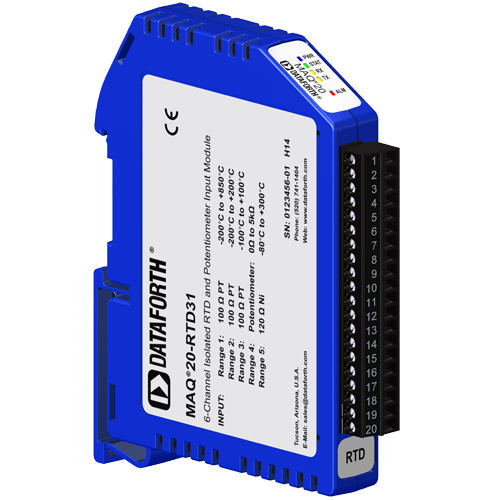
MAQ20-RTD31
Analog Input Module: 2-wire or 3-wire RTD/Potentiometer, 6 Channels, Type Pt and Ni
MAQ20-RTD31
Analog Input Module: 2-wire or 3-wire RTD/Potentiometer, 6 Channels, Type Pt and Ni
Description
Two MAQ20 resistance input modules are offered. One interfaces to 3-wire sensors and has 6 input channels; the other interfaces to 4-wire sensors and has 5 input channels. The 3-wire module interfaces to 3 types of sensors: 100Ω Pt and 120Ω Ni RTDs, and potentiometers; the 4-wire module interfaces to 100Ω Pt and 120Ω Ni RTDs. Precision, low magnitude current sources are used to minimize sensor self-heating and cancel lead resistance errors when using 3-wire sensors. All channels are individually configurable for sensor, range, alarms, and averaging to match the most demanding applications. High, Low, High-High and Low-Low alarms provide essential monitoring and warning functions to ensure optimum process flow and fail-safe applications. Hardware low-pass filtering in each channel provides rejection of 50 and 60Hz line frequencies. Field I/O connections are made through a pluggable terminal block with positions designated for the termination of wiring shields.
Input-to-bus isolation is a robust 1500Vrms and each individual channel is protected up to 240Vrms continuous overload in case of inadvertent wiring errors. Overloaded channels do not adversely affect other channels in the module, which preserves data integrity.
Channels in a module can be selectively enabled for scanning. All channels are enabled by default; however, non-used channels can be disabled to increase the sampling rate of enabled channels.
Input sensors and input ranges are selectable on a per-channel basis. One to three ranges are available depending on the input sensor. Over-range and under-range up to 2% beyond the specified input values is allowed. Sensor linearization is performed in the module, and accuracy is guaranteed to ±f.s.
Features
- 6 Input Channels for 3-Wire Sensors
- 5 Input Channels for 4-Wire Sensors
- Interface to Pt100, Ni120 RTDs, and Potentiometers
- All Channels Individually Configurable for Sensor, Range, Alarms, Averaging
- 1500Vrms Input-to-Bus Isolation
- Each Channel Protected up to 240Vrms Continuous Overload
- Selective Enabling of Module Channels for Scanning
- UL/cUL (Class I, Division 2, Groups A, B, C, D)
Block Diagram

Documents
MAQ20 Module & Accessory 3-D CAD Models
Certifications

Specifications
- Sensor Type RTD/Potentiometer
- Input Range 6-channel, 2-wire or 3-wire Pt100, Ni120, Potentiometer Input, 100Ω Pt α = 0.00385; –200°C to +850°C (Default), 100Ω Pt100 α = 0.00385; –200°C to +200°C, Pt100 α = 0.00385; –100°C to +100°C, Ni120 α = 0.00672; –80°C to +300°C, Potentiometer 0Ω to 5kΩ
- Output Range
- Communication Via MAQ20-COM2 / -COM4
- Protocol Modbus TCP/IP or RTU
- Mechanical Format DIN rail mounting
- Isolation Voltage 1500Vrms
- Accuracy ±0.06% span
- Linearity ±0.035% span
- Cold Junction Compensation
- Supply Voltage / Current 35mA
- Input Voltage Protection 240Vrms max
- Output Voltage Protection
- Bandwidth, -3dB 3Hz
- Scan / Update Rate 200 Ch/s
- NMR (60 Hz) Rejection 20dB at 50/60Hz
- Output
- Excitation Voltage
- Dimensions 4.51” x 0.60” x 3.26”
- Operating Temperature –40°C to +85°C
- Weight 87 grams (3.07 ounces)
Accessories
Competitive Cross-Reference
- No cross reference is available.
This information is provided only as a convenience on an "as is" basis and Dataforth Corp. or its representatives or distributors are not responsible for any incorrect, inaccurate, or incomplete information. You are solely responsible for (1) selecting the appropriate Dataforth products for your application, (2) designing, validating and testing your application, and (3) ensuring your application meets applicable standards, and any other safety, security, or other requirements.
FAQ